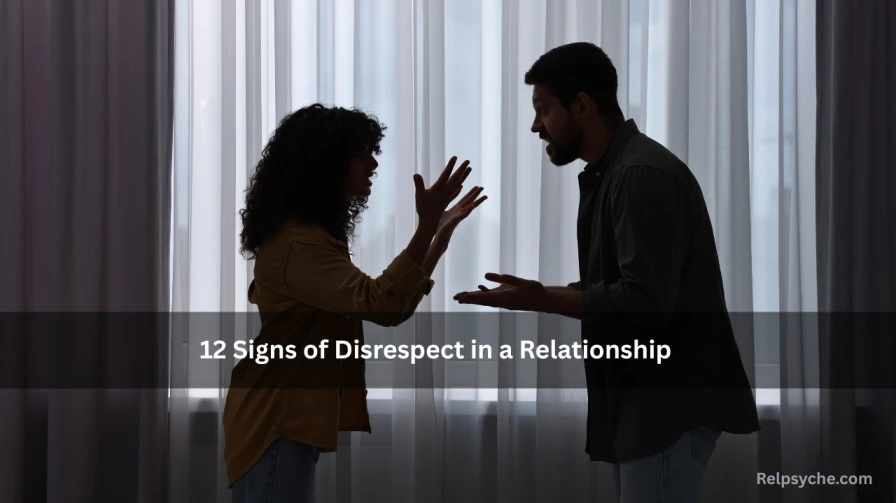
12 Signs of Disrespect in a Relationship
A partner may disrespect you for various reasons, but none of them justify the behavior. Sometimes it stems from emotional immaturity: people who don’t know how to manage their frustrations and take out their anger on whoever is closest. Other times it arises from family dynamics, where yelling, mockery, or belittling were normalized.
It can also happen when there’s a power imbalance or when one person believes they have the right to control the other. Disrespect may appear when your partner ignores your emotions or assumes you will always forgive everything. In many cases, disrespect grows gradually, starting with small gestures that become habitual. Over time, this pattern weakens trust, affection, and emotional safety, making the relationship feel painful instead of supportive.
Table of Contents
12 signs of disrespect in a relationship
1. Minimizing your emotions
When they respond with “you’re exaggerating,” “it’s not a big deal,” or “you always dramatize,” they invalidate your emotional experience. This slowly destroys your self-confidence and makes you afraid to express your feelings. Over time, you start doubting your own perception of reality. Emotional invalidation is one of the earliest markers of an unhealthy relationship.
2. They speak to you with a superior tone
The tone of voice reveals more than the words themselves. A patronizing or sarcastic tone signals contempt. This communication style creates an emotional gap where you no longer feel like equals. If the tone never changes, it becomes a form of psychological domination.
3. They humiliate or ridicule you
Cruel jokes, exposing personal flaws, or making fun of you in front of others are acts of humiliation. Even when disguised as “teasing,” the deeper intention is to diminish your worth. This kind of disrespect chips away at your sense of safety and belonging.
4. Ignoring your boundaries
If you say “this hurts me,” “don’t talk like that,” or “I need space,” and they ignore it, your boundaries are not being respected. Over time, you begin to feel invisible or unimportant. When boundaries are ignored repeatedly, it signals a deeper disregard for your emotional well-being.
5. They blame you for everything
If every argument somehow becomes “your fault,” you are being manipulated. This reflects emotional immaturity and a lack of accountability. When you carry all the blame, you begin to question your own intuition, even when you did nothing wrong.
6. Controlling your decisions
Dictating what you wear, who you talk to, or how you spend your time is not “concern”—it is control. This behavior limits your freedom and slowly isolates you from your support system. Control is a major warning sign that can escalate into emotional abuse.
7. Comparing you to other people
Comments like “my ex never did this” or “other partners are better” are meant to make you feel inferior. These comparisons weaken your self-esteem and create insecurity. Respectful partners uplift—you, not replace you with imaginary standards.
8. Disparaging your achievements
Minimizing your success or mocking your goals is emotional sabotage. A real partner celebrates your growth, not competes with it. When they downplay your victories, it shows envy and insecurity.
9. Yelling or speaking rudely when angry
Yelling is not a personality trait—it is verbal aggression. Respect should remain even during disagreements. Over time, being yelled at makes you anxious, guarded, and emotionally unsafe.
10. Making you afraid of their reaction
If you filter your words or hide mistakes because you fear criticism or anger, the relationship has become harmful. Fear should never be part of love. This dynamic erodes trust and makes you feel trapped.
11. They don’t listen to you
Interrupting, dismissing, or ignoring you makes you feel unimportant. Listening is a basic act of respect. When it doesn’t exist, emotional intimacy becomes impossible.
12. Punishing you with silence
Silent treatment, emotional withdrawal, or ignoring messages are forms of emotional control. This behavior is meant to make you feel guilty, desperate, or obedient. It is one of the clearest signs of emotional manipulation.
Examples and phrases that indicate disrespect
Disrespect is not always loud—sometimes it hides in casual phrases. Comments like “you talk nonsense,” “you’re too sensitive,” or “you don’t understand anything” invalidate your thoughts. Phrases such as “you’re pathetic” or “shut up already” reveal deep contempt.
Sarcasm like “I was just joking, you can’t take anything” turns the blame on you instead of acknowledging the hurt. Even emotional withdrawal, ignoring messages, or refusing to talk can be a form of punishment. If these phrases feel familiar, it’s not exaggeration—you are recognizing emotional harm.
What to do when your partner disrespects you?
The first step is not to normalize it. Tell your partner clearly which behavior hurt you and state your boundary: “I will not accept being spoken to this way.” After that, observe their actions—not their apologies. Meaningful change requires consistency, commitment, and accountability.
If the disrespect continues, distance yourself emotionally and consider counseling. You deserve a relationship built on mutual respect, not fear or discomfort. Protect your self-worth and prioritize your emotional safety above any relationship.
When does disrespect become emotional abuse?
Disrespect becomes emotional abuse when it is constant, intentional, and meant to control you. Repeated insults, belittling, manipulation, or silent treatment are all methods designed to break your self-esteem. Emotional abuse often starts subtly but intensifies over time.
If you feel afraid to speak, constantly guilty, or monitored emotionally, you are no longer in a normal relationship—you are experiencing psychological abuse. At that point, seeking support is essential. Your emotional safety must always come first.

Conclusion
Recognizing the signs of disrespect in a relationship is essential for protecting your emotional well-being. Respect is the foundation of trust, safety, and healthy communication, and without it, even strong love begins to weaken. When you notice behaviors like mocking, yelling, belittling your feelings, or ignoring your boundaries, these are not small issues — they are clear signs of disrespect in a relationship that should never be ignored.
By paying attention to these warning signals and understanding what they truly mean, you can make informed decisions about your future. Whether the relationship can heal depends on whether your partner takes real responsibility and commits to change. If the signs of disrespect in a relationship continue, you must prioritize your dignity and emotional safety. You deserve a relationship where respect is steady, consistent, and unconditional.
Ready to take the next step in your personal growth? Explore expert services — from therapy to life coaching — available on Fiverr.
If you want to read more articles similar to 12 Signs of Disrespect in a Relationship, you need to know that we recommend that you enter our Relationships category.
FAQs
1. What are the most common signs of disrespect in a relationship?
The most common signs of disrespect in a relationship include minimizing your emotions, mocking your opinions, yelling, ignoring your boundaries, controlling your choices, or shutting you out through silence. These behaviors slowly damage trust and emotional connection. Identifying these signs of disrespect in a relationship early helps you protect your self-esteem.
2. Why does my partner disrespect me even if they say they love me?
Sometimes people say they love you but still show the signs of disrespect in a relationship because of emotional immaturity, learned family patterns, insecurity, or control issues. These may explain their behavior, but they never justify it. True love must be expressed with consistent respect, not just words.
3. Can the signs of disrespect in a relationship be fixed?
Yes, but only when both partners recognize the signs of disrespect in a relationship and take real steps to change them. Honest communication, accountability, therapy, and healthy boundaries are necessary. If disrespect continues even after clear conversations, it shows the behavior is deeper and may not improve.
4. When do signs of disrespect in a relationship become emotional abuse?
The signs of disrespect in a relationship turn into emotional abuse when they are constant, intentional, and designed to belittle or control you. This includes ongoing insults, humiliation, fear-based reactions, silent treatment, or manipulation. If you feel scared, small, or monitored, the situation has crossed from disrespect to abuse.
5. What should I do if the signs of disrespect in a relationship keep happening?
If you repeatedly see the signs of disrespect in a relationship, start by setting firm boundaries and expressing how the behavior affects you. If nothing changes, prioritize your mental and emotional well-being. Distance, support from trusted people, or professional help may be necessary. No relationship can be healthy without mutual respect.
References
- American Psychological Association. (2023). Emotional Abuse: What It Is and How to Recognize It. APA Psychology Topics.
- Gottman, J., & Silver, N. (2015). The Seven Principles for Making Marriage Work. Harmony Books.
- University of California, Berkeley – Greater Good Science Center. (2022). The Science of Respect and Healthy Relationships.
- National Domestic Violence Hotline. (2023). Warning Signs of Emotional and Verbal Abuse.
- Psychology Today. (2023). The Dynamics of Disrespect in Relationships.
- Lindsay, M., & Crespo, C. (2019). Emotional Invalidation and Its Consequences. Journal of Family Psychology.
- Markman, H., Stanley, S., & Blumberg, S. (2010). Fighting for Your Marriage. Jossey-Bass.
- Centers for Disease Control and Prevention (CDC). (2023). Healthy Relationships & Communication.
- Karney, B. R., & Bradbury, T. (2020). Relationship Dynamics and Long-Term Stability. Annual Review of Psychology.
- National Institute of Mental Health (NIMH). (2022). Stress, Emotional Health, and Relationship Behavior.
- Cinquegrana, V., Marini, M., & Galdi, S. (2023). Psychological abuse is not a problem! Exploring the role of domestic violence myths in psychological revictimization. Frontiers in Psychology, 14, 1228822. https://doi.org/10.3389/fpsyg.2023.1228822
- Dokkedahl, S.B., Kirubakaran, R., Bech-Hansen, D., Kristensen, TR, and Elklit, A. (2022). The psychological subtype of intimate partner violence and its effect on mental health: a systematic review with meta-analyses. Systematic Reviews, 11(1), 163. https://doi.org/10.1186/s13643-022-02025-z
- Karakurt, G., Koc, E., D’Silva, R., Oğuztüzün, Ç., Choudhary, A., Goto, T., Gao, K., & Bolen, S. (2025). Systematic review on the treatment of emotional abuse victimization in women by an intimate partner. Journal of Family Violence. https://doi.org/10.1007/s10896-025-00891-4
- McLindon, EV, Brown, C., McKenzie, M., Tarzia, L., & Hegarty, K. (2025). Development and Validation of the Psychological Abuse in Relationships scale. Journal of Interpersonal Violence, 8862605251325912. https://doi.org/10.1177/08862605251325912

I’m Emma Johnson, a psychologist who loves to write and share ideas.
I enjoy making psychology simple so everyone can understand and use it in daily life.
If you’d like to talk, ask questions, or work together, feel free to reach out.
Let’s learn and grow in the world of psychology together!