
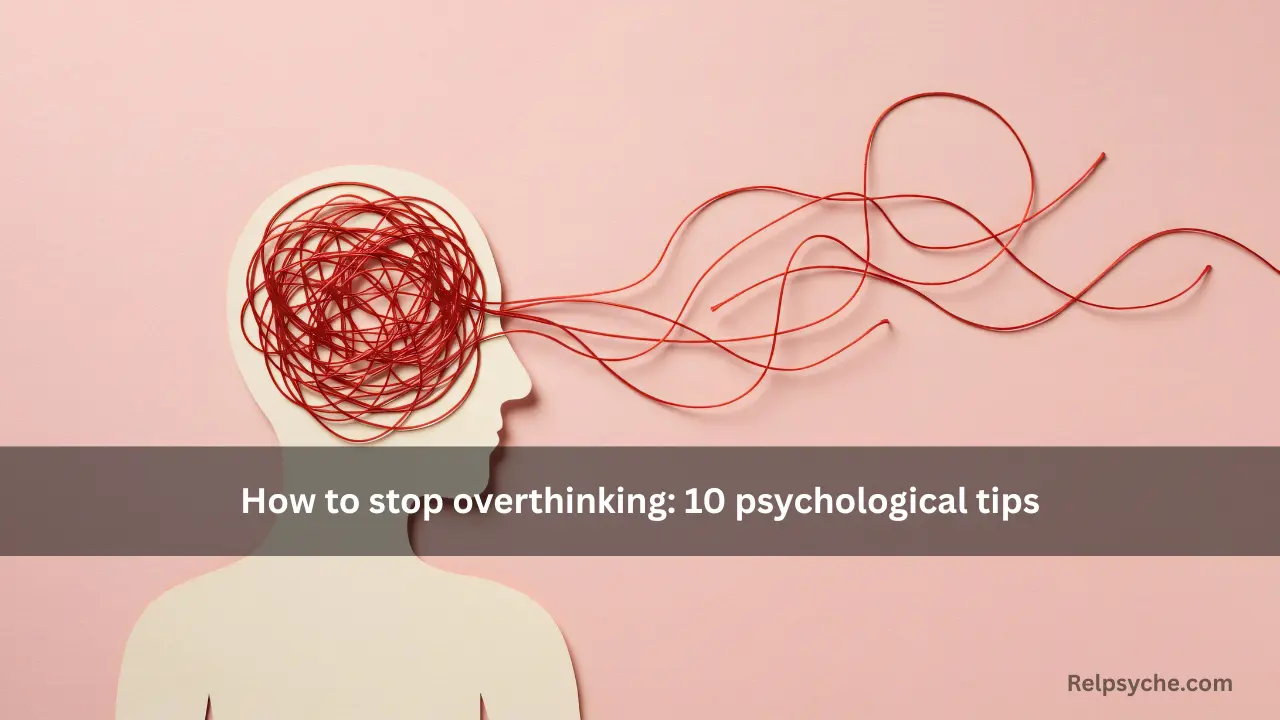
How to stop overthinking: 10 psychological tips
Have you ever felt like your mind won’t shut off? Do you keep going over the same things, imagining scenarios, analyzing every word you said, or anticipating what could go wrong? If so, you’ve probably been overthinking, a habit that can drain all your energy, increase anxiety, and leave you feeling stuck in life.
The good news is that you can train your mind to break free from this cycle. Stopping overthinking doesn’t mean “stopping thinking,” but rather thinking purposefully, without getting stuck on what you can’t change. Mental rumination can be transformed into writing, movement, or reconnecting with the present moment.
Table of Contents
1. Identify when you are overthinking
Although it may seem obvious, the first step is to identify mental rumination, since overthinking usually happens on autopilot. Therefore, start observing your internal dialogue and ask yourself: “Is this helping me or is it just exhausting me?”
According to therapist Emma McAdam, simply naming what is happening—for example, telling yourself “I’m ruminating”—activates a part of the brain associated with self-regulation and can help you stop the spiral.
2. Difference between reflecting and ruminating
While reflection is constructive, rumination consists of repeating the same thought over and over without reaching a conclusion. In fact, cognitive behavioral therapy (CBT) teaches that rumination doesn’t solve problems, but rather amplifies distress.
So ask yourself: ” Am I looking for solutions or just reliving the problem? “, “Does this bring me closer to change or does it paralyze me?”, and if you’re not finding a practical way out, let go of the problem.
3. Set aside “time to worry”
Metacognitive psychology suggests scheduling a specific time of day to process worries (for example, 20 minutes in the afternoon). Then, when intrusive thoughts arise outside of that time, write them down and promise yourself to review them during that time. This will help you regain control over your mind instead of letting your thoughts disrupt your entire day.
4. Put your thoughts on paper
Therapeutic writing is a technique that helps process emotions and organize the mind. One way to process your problem is as follows: First, describe the event, that is, what happened or what is worrying you. Then, write about the emotion or how you feel. Finally, reflect on what you can do about it. In this way, writing will help you bring your thoughts out of the mental turmoil and make them visible and manageable.
5. Change the questions you ask yourself
Overthinking often thrives on circular questions like, “Why did this happen to me?” or “What if I’m wrong?” Replace them with empowering questions. For example: “What can I learn from this?” or “What’s the next step I can take?” This shift in focus—from guilt or fear to learning and action—is fundamental to personal growth.
6. Practice mindfulness
Overthinking anchors us to the past or projects us into the future. Mindfulness , on the other hand, brings us back to the present. It’s not about “emptying the mind,” but about observing without judgment.
You can start with something simple: feeling your breath, listening to the sounds around you, or focusing on the sensations in your body. Studies have shown that mindfulness reduces rumination and improves emotional regulation.
7. Move your body
Overthinking creates physical tension: hunched shoulders, a clenched jaw, shallow breathing… Movement helps release that pent-up energy. Walking, exercising, stretching, or dancing can break the mental loop.
Physical activity shifts the focus of attention and increases the production of mood-enhancing neurotransmitters such as dopamine and serotonin.
8. Question your thoughts
When you notice thoughts like “I’m sure to fail” or “nothing will go right,” don’t accept them as truths. Instead, ask yourself if you have any evidence to support them, what other explanation there might be, and, above all, what advice you would give a friend.
This type of cognitive restructuring is central to cognitive-behavioral therapy, as it reminds us that thoughts are not facts but interpretations and that we can choose a more realistic version of them.
9. Practice self-compassion
An overthinking mind is often a demanding mind. Sometimes we believe that if we analyze everything, we’ll avoid mistakes or disappointments. However, the reality is that we end up exhausted.
One tip for stopping overthinking is to replace excessive demands on yourself with self-compassion —that is, treating yourself with the same kindness you would show someone you love. American psychologist Kristin Neff demonstrated that those who practice self-compassion experience less anxiety and rumination. So keep in mind that you might be doing the best you can with what you know.
10. Ask for help when you need it
If overthinking has become a constant source of anxiety, insomnia, or mental blocks, seek professional help . Cognitive behavioral therapy and metacognitive therapy have been shown to be effective in reducing rumination and obsessive thinking. Take care of your mind the same way you would take care of your body.

Conclusion
Overthinking is something many people struggle with, but it does not need to take control of your life. By learning to notice when it is happening, challenging your thoughts, and practicing healthy techniques like mindfulness, journaling, movement, and self-compassion, you can slowly train your mind to stay grounded. Over time, these habits help you think more clearly, make better decisions, and gain emotional stability. With patience and consistency, your mind can become a place of balance, focus, and peace rather than stress and worry.
Ready to take the next step in your personal growth? Explore expert services — from therapy to life coaching — available on Fiverr.
If you want to read more articles similar to How to stop overthinking: 10 psychological tips, You Need to Know, we recommend that you enter our Psychology category.
FAQs
1. Is overthinking a mental health disorder?
No. Overthinking itself is not a disorder, but it can be a sign of other issues like stress, anxiety, or low confidence. If it happens often, it may mean your mind is trying to protect you, but using an unhelpful method. Building awareness and using healthier coping strategies can reduce the pattern and increase emotional control.
2. How long does it take to stop overthinking?
There is no fixed timeline, as it depends on commitment and the person’s emotional habits. Many people notice changes within a few weeks when they practice techniques like mindfulness, journaling, and thought reframing daily. The more consistent you are, the faster your brain learns new, healthier thinking patterns.
3. Can overthinking affect my sleep?
Yes, overthinking is one of the biggest causes of difficulty falling asleep or waking up with a restless mind. When your brain stays active at night, it stops the body from entering a relaxed state. Using habits like writing down thoughts, reducing screen time, or creating a nighttime routine can help quiet the mind and improve sleep quality.
4. Is distraction a healthy way to stop overthinking?
Healthy distraction can be useful when thoughts feel overwhelming. Activities like walking, exercise, hobbies, or talking to someone can break the mental cycle and give your brain space to reset. However, distraction works best when combined with deeper strategies, like questioning thoughts or calming the nervous system, so the problem is addressed long-term.
5. When should I seek professional help?
You should consider professional support if overthinking is causing daily stress, insomnia, emotional exhaustion, or difficulty functioning at work, school, or in relationships. Therapies like CBT and metacognitive therapy have proven success in reducing rumination. Reaching out for help is a strong and positive step toward mental well-being.
References
- McAdam, E. (2022). 6 therapy skills to stop overthinking everything. Therapy in a Nutshell. Retrieved from:https://therapyinanutshell.com/6-therapy-skills-to-stop-overthinking-everything
- Wells, A., Matthews, G. (1994). Attention and emotion: A clinical perspective. Lawrence Erlbaum Associates.
- Pennebaker, J. W. (2018). Expressive writing: Words that heal. Idyll Arbor.
- Keng, S.L., Smoski, M.J., Robins, C.J. (2011). Effects of mindfulness on psychological health: A review of empirical studies. Clinical Psychology Review, 31(6), 1041–1056.
- Neff, K. D. (2011). Self-compassion: The proven power of being kind to yourself. HarperCollins.
- Normann, N., van Emmerik, A.A.P., Morina, N. (2014). The efficacy of metacognitive therapy for anxiety and depression: A meta-analytic review. Depression and Anxiety, 31(5), 402–411. https://doi.org/10.1002/da.22273

I’m Emma Johnson, a psychologist who loves to write and share ideas.
I enjoy making psychology simple so everyone can understand and use it in daily life.
If you’d like to talk, ask questions, or work together, feel free to reach out.
Let’s learn and grow in the world of psychology together!